When you price up a roof, lay a new floor, or frame a stud wall, you’re likely to come across carcassing timber, though you may not recognise it initially. This hidden boning of every building plays a key role in the integrity and longevity of a structure.
Across building sites, carcassing timber plays the heavy lifting role, behind your plasterboard or floorboards. To break it down for you simply, it is the frame that everything else is fixed to, built around or hung from; the foundation, as it were.
Let’s examine the features of carcassing timber that make it an important substructure in most projects.
What Is Carcassing Timber Used For?
You might not know just how many applications this timber covers. While roof rafters, ridge boards, and ceiling joists are the most common uses for carcassing timber, it also forms the sole plates and head plates in stud wall partitions, the trimmer and header joists around openings, floor joists in timber-framed floors, and the firring pieces used to create a fall on a flat roof.
In your standard terraced house renovations, carcassing timber is present on the ground floor, all the way up to the home’s ridge.
Because it's designed to be hidden within a structure, appearance is largely irrelevant. What matters is strength, dimensional stability, and whether it's been treated to resist the moisture and fungal exposure that can develop when timber is enclosed inside walls or roof spaces.
Strength Grades: C16 vs C24
You'll often see carcassing timber graded as C16 or C24. These are European strength classes, with C24 being the stronger timber.
For most standard domestic applications, namely floor joists, rafters, and stud work, C16 is normally enough. Structural engineers and building control often specify C24 for longer spans or heavier loads. If in doubt, check your drawings or call your building control officer.
What Is Sawn Carcassing Timber?
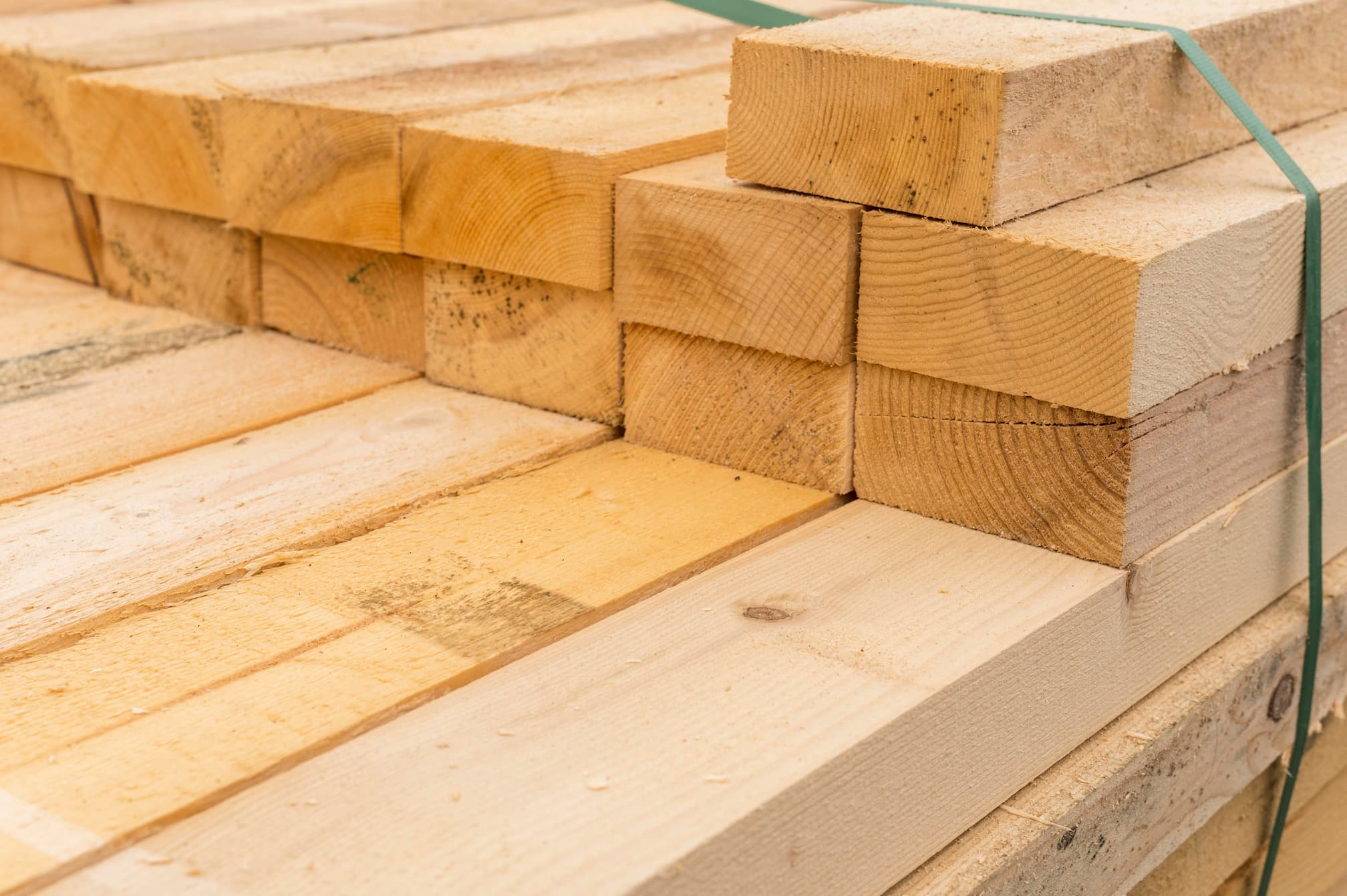
Sawn carcassing timber is exactly what it sounds like: timber that has been cut to size at the sawmill and sold in that rough-sawn state, without being planed smooth. The surface is coarser than finished timber, the edges may be slightly irregular, and the dimensions can vary from piece to piece.
In structural applications hidden inside a building, this works, as; rafters don’t need to be smooth to do what they’re designed to.
The practical upside of sawn timber is cost. It isn’t planed, making it more affordable than planed timber and regularised timber, and for high-volume structural work, that's real savings across a project.
Regularised carcassing timber is brilliant in applications where consistent dimensions genuinely matter, studwork partitions and floor joists being the obvious examples, where any variation in depth or thickness will translate directly into an uneven floor or a wall that rocks.
Can Carcassing Timber Be Used Outdoors?
Many ask this, and it depends on which type of carcassing timber you buy. If you go for untreated timber, only use it internally. It can deteriorate rapidly through rot and fungal decay, especially with consistent rainfall.
Treated carcassing timber, however, is a different matter. Timber treated to Use Class 3 has been pressure-treated with preservative to resist the above-ground outdoor exposure it would face in a decked area, a pergola, a fence structure, or a garden outbuilding.
The green tint you often see on treated timber is a sign of this preservative. For in-ground contact, for instance, fence posts set into soil, you need to use Class 4 timber, as it carries a higher level of preservative retention.
The simplest rule: if it's going outside and could get wet, always buy treated. The price difference over untreated is small, and the savings in replacement costs and labour down the line are significant.
A Note on Kiln Drying and Movement
Freshly sawn, sometimes known as green carcassing timber, contains a high moisture content, and as it dries in service, it will shrink and can distort. Kiln-dried timber has had that moisture removed before it reaches the merchant, which means less movement once it's built into the structure.
For floor joists and roofwork where the timber is enclosed fairly quickly, green timber is often fine. Where dimensional stability matters from day one, in something like a studwork wall that needs to be boarded immediately, go for kiln-dried timber.
Sourcing Carcassing Timber in Yorkshire
Finding reliable carcassing timber is key, with a range available here at Joseph Parr Bradford.
If you’d like advice on timber, get in touch with us, a timber merchant with over a century of experience.