
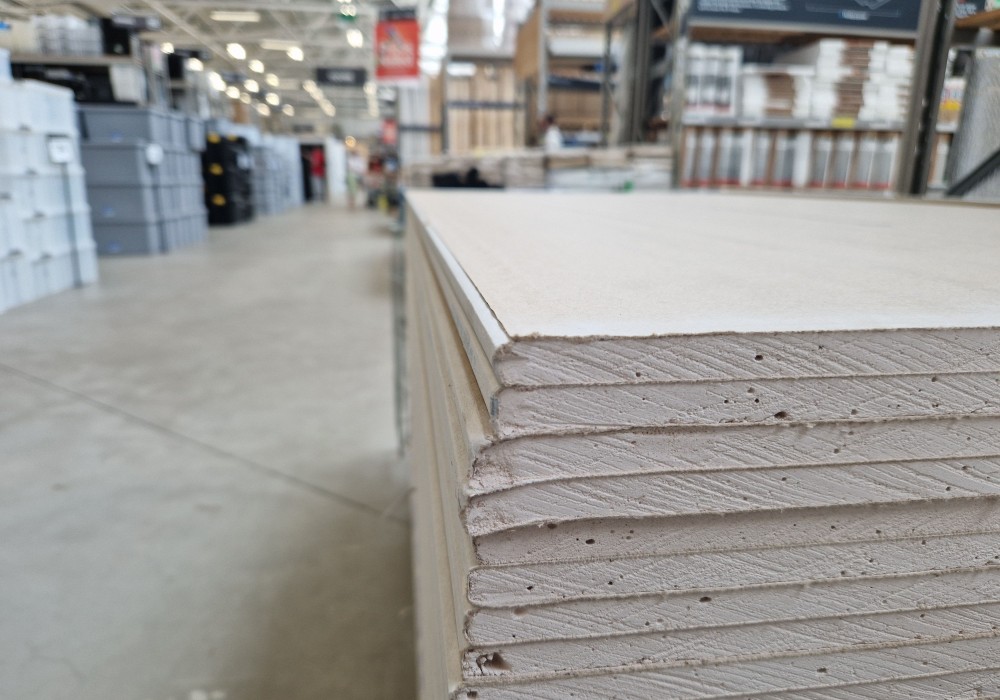
Plasterboard isn't a single product. There are five main types in common use, each with a different core composition, and putting the wrong one in the wrong place either fails an inspection or fails in use. This guide covers what each board is designed for, where it shouldn't go, and the sizes and thicknesses you'll encounter on most jobs.
What Are The Main Types of Plasterboard?
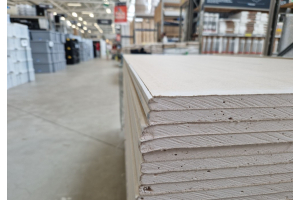
Standard plasterboard is the default for dry internal walls and ceilings where there's no moisture risk, no fire requirement and no acoustic consideration. Ivory or white faced, available in multiple sizes, and it's what the majority of residential first and second fix work is done with. If the room is dry and internal, this is usually the right board.
Moisture resistant plasterboard has a green tinted face and core treated to handle humidity and occasional moisture exposure. It is great for kitchens, bathrooms, and utility rooms, especially behind tiles. Remember, it isn’t waterproof.
Fire resistant plasterboard has a pink or red face and glass fibre reinforcement through the core that slows fire spread. It's used on party walls, fire compartment walls and ceilings where building regulations require a fire rating. The rating depends on thickness and the number of layers, so check the spec before ordering.
Acoustic plasterboard is denser than standard board, and that density is what improves sound attenuation. Used on party walls, dividing walls between bedrooms and home studio builds. No plasterboard eliminates sound. Acoustic board reduces transmission, and how well it performs depends on the full wall build, including the frame, insulation and any flanking paths.
Insulated plasterboard is a foil-backed board with PIR insulation bonded to the back. Used for dry lining external and solid walls where thermal performance needs to improve without the space loss of a separate stud wall. More on this below.
Types at a Glance
Board Type | Colour Code | Best For | Avoid In |
Standard | Ivory white | Dry internal walls and ceilings | Wet areas, fire walls |
Moisture resistant | Green edge/face | Kitchens and bathrooms behind tiles | Direct water without a membrane |
Fire resistant | Pink/red | Party walls and fire compartments | Where an acoustic rating is needed |
Acoustic | Varies by brand | Party walls, bedrooms, and home studios | Where fire ratings are required |
Insulated | Foil-backed | External and solid walls | Internal partitions |
Plasterboard Sizes and Thickness
Standard sheet dimensions are 1200mm wide. The lengths you'll come across most often are 1800mm, 2400mm and 2700mm, with 2400mm being the most common on residential work. Longer boards mean fewer joints, which matters on ceilings and tall walls, but they're harder to handle solo.
Thickness is where the specification decisions sit.
9.5mm is used primarily on ceilings where weight matters and the board will be skim finished. It's lighter and easier to lift, but it has less rigidity than 12.5mm, so the framing centres need to be tighter.
12.5mm is the standard thickness for most internal applications. It's what you'll use on timber or metal stud partitions in most residential and light commercial jobs.
15mm is used where increased rigidity is needed, on walls that will take heavy fixings, or where a fire rated build-up requires the additional thickness. It's heavier to handle but more robust once fixed.
25mm and above puts you into insulated plasterboard territory, where the overall thickness is made up of the board face plus the bonded insulation layer behind it.
Insulated Plasterboard
Given how much search interest this product attracts, it's worth going into more detail.
Insulated plasterboard bonds a layer of PIR foam insulation to the back of a standard plasterboard face. The foil backing reflects heat and the insulation reduces thermal transmission through the wall.
It's particularly useful on solid external walls in older properties, on garage conversions where the masonry is uninsulated, and in rooms that run cold due to thermal bridging at junctions. Available insulation thicknesses typically run from 25mm up to 100mm or more depending on the manufacturer, with the plasterboard face adding 12.5mm on top of that. What thickness you need depends on the existing wall construction and the U-value you're working to.
What Thickness Plasterboard Should You Use?
As a straightforward guide: 9.5mm for ceilings, 12.5mm for standard internal walls, 15mm where rigidity or fire performance is required. If the job involves a specific fire or acoustic rating, the board manufacturer's system specification will set out the required thickness and build-up, and that should be followed rather than substituted.
Find Plasterboard in Bradford
Plasterboard is available in multiple sizes and types, and we hope you now have a clearer idea, so that you can complete the job successfully.
Get yours right here at Joseph Parr Bradford, or get in touch for help with specifications and quantities.